Saturday, January 29, 2011

Thanks, Janet


Just read this September 2010 post, "Justice for All: Some Thoughts on Character Education," by poet and children's writer Janet Wong, on Unabridged, Charlesbridge Publishing's blog.

"The start of the school year is the perfect time to think Grand Thoughts," Janet writes, "and few thoughts are grander than those in our pledge of allegiance. Just for fun, you might try to write a variation that emphasizes what is most important to you. Here's mine:

Liberty
by Janet Wong

I pledge acceptance
of the views,
so different,
that make us America

To listen, to look,
to think, and to learn

One people
sharing the earth
responsible
for liberty
and justice
for all."

A Grand Thought indeed, a piece of wisdom for these fractious times.

Thursday, January 20, 2011

Moving Forward

I live in Maine, so I've spent many hours over the last week thinking, reading and talking about our newly elected governor's response, which made national news, when he was questioned about his refusal of multiple invitations to attend events sponsored by the local NAACP chapter.

I've reflected at length on what I wanted to say that hasn't already been said wonderfully by others, including some brilliant friends of mine, Rachel Talbot Ross, state director and local chapter president of the NAACP, and Catherine Anderson of "Mama C and the Boys."

There is the dismay of hearing such coarse and dismissive language coming from the state's highest official, to some of those he is supposed to be serving. There is the concern - beginning with LePage's very first executive order, to rescind the previous governor's order that state agencies could not inquire about the immigration status of individuals seeking services - that the new governor doesn't see constituents of color as true Mainers. There is the distaste of hearing LePage offer up the young Jamaican man who has become part of their family as proof that he doesn't have a problem with race (though nobody had suggested he did). There is the disappointment of once again hearing a white man accuse people of color of "playing the race card." There's the thought of four long years ... Where to start?

But a few days later, I see opportunities.

On Monday, people kept streaming into the Preble Street Resource Center in Portland for small-group discussions before the planned Martin Luther King Day march to City Hall. Originally envisioned as a conversation about economic justice, the conversations kept returning to the issue of LePage's remarks, and many people said that's what had motivated them to attend. Propelled by our reaction against what we didn't want, we were moved to show up, stand up and speak up for what we did want: welcoming, connection, unity.

That same Monday morning, Effie McLain, a black minister, offered reconciling words, an outstretched hand, and an invitation to dance when LePage unexpectedly showed up at the MLK breakfast in Waterville. She acknowledged that his "foolish" words had caused pain, but urged people to stop beating up on him and to move forward.

LePage's remarks are a wake-up call that we still have a lot of work to do. When people behave like this, our first response is often to distance ourselves as quickly and as far as possible from them. Especially if we're white, we want to make it clear that we're not like them. One of the trickiest yet most essential pieces of the work is not to divide ourselves from anyone as we work to overcome division. Instead of judging, how can we reach out a hand to those who feel that our increasingly diverse population is somehow a threat to them?

We can have the honest, ongoing conversations about race that we avoid for fear of discomfort. We can recognize the places in ourselves where we are fearful, defensive, blind. Then, with humility and without judgment, we can listen and talk to others until we create what we want: welcoming, connection, unity.

Wednesday, January 19, 2011

Yum!!

Last week, just before a joint school visit with author Reza Jalali in Brunswick, Maine, we received this email:

The Jordan Acres staff is cordially invited to a buffet lunch
served in the library Friday January 14 from 11:45 – 1:00.
Please help the library welcome authors
Reza Jalali and Anne Sibley O’Brien.
A Middle Eastern inspired menu has been selected to celebrate the book
The Moon Watchers written by Mr. Jalali and illustrated by
Ms. O’Brien.

Menu

Iraqi Flat Bread (freshly baked Friday morning)

Curried Chicken Soup with Carrots (an Israeli recipe)

Tabouli (Lebanese salad)

Vegetable Dol Made (Arabic recipe with wrapped grape leaves, rice, & vegetables)

Hummus (freshly made by StarEast Café in Portland)

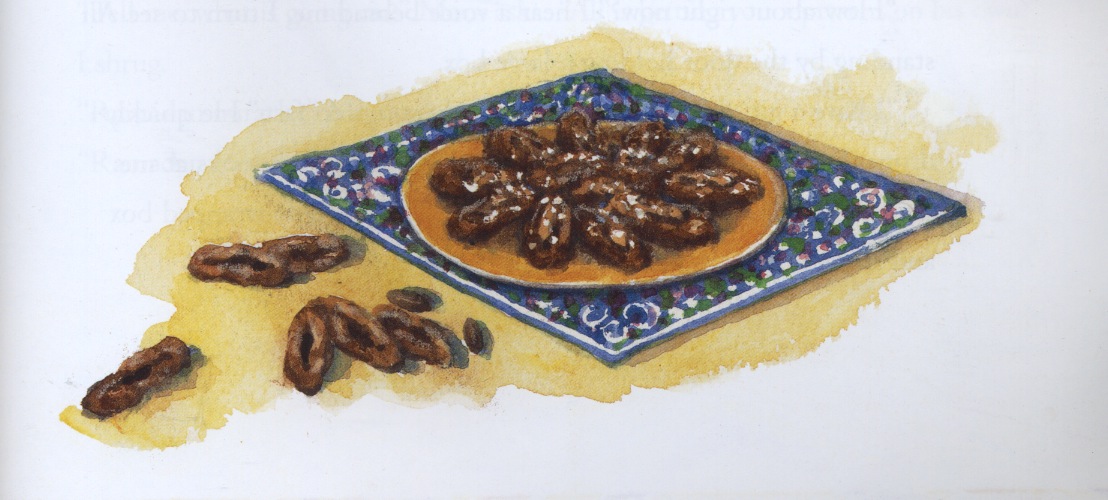
Fatima’s Fingers (Tunisian recipe using egg, ricotta cheese, & phyllo)

Ghorayyibah (Egyptian sugar
cookies)

Dates (from Saudi Arabia)

The feast was a delicious treat for everyone, and a good chance to relax with staff members between presentations to grades 3, 4 and 5. The students had been well-prepared to engage with us, all thanks to librarians Margy Soule and Persephone Ditzel. I love my job!

Moon Watchers: Shirin's Ramadan Miracle, about an Iranian-American family's observance of Ramadan, is, of course, about fasting, but it's also full of the delights of the special foods prepared to break the fast.


For the next decade or so, Ramadan dates will fall during summer months when schools are not in session, but learning about the observance can happen anytime during the year. Find an extensive list of internet resources on Islam, and activities, discussion questions and a recipe for Persian Rice, in the Teachers Take Note section of Tilbury's website.


Sunday, January 16, 2011

Looking for Loopholes

One of the blogs I've been enjoying recently is Resist Racism, an Asian-American male perspective - sharp, smart, fierce and funny. One of the features of the blog is Racism 101, "an ever-expanding list of common understandings we share as anti-racists." ("1. White privilege exists.")

Number 8, "Defensive responses to issues voiced by people of color are invocations of privilege," has provoked a long exchange of comments, mostly between one questioner (whose race is never identified but is clearly speaking out of the white experience) trying to clarify definitions, and a very generous and patient person providing a lot more information.

It's a rich and substantive conversation, but eventually the white person concludes: "At this moment, as a person open to hear the more nuanced perspectives on racism, I’m walking away from this with a sense that it’s over-thought excuse making."

From the overall exchange and the outcome, it appears that what the questioner was seeking was not true understanding, especially of the discomfiting type, but justification. All his/her effort was concentrated on dissecting what words meant, rather than imagining how the idea might pertain to his/her own experience. What a missed opportunity, all the more ironic because the person was engaging in the very defensive responses that #8 describes.

This is familiar territory to me. I've spent many uncomfortable hours twisting my brain and heart into pretzels, trying to construct a reality that justified ... me. This is indeed "an invocation of privilege," because I'm making it all about me.

And, blessedly, over the years I've discovered that I can choose another path. Seeking racial awareness and understanding can be a process of liberation, a continually unfolding journey. When a person of color raises an issue of race, you can:

Start with the assumption of your own goodness.
When we feel compelled to defend and justify ourselves, it usually means that we're afraid we might be guilty. Harmful patterns of white socialization exist, and denial, guilt and blame hold them in place. The way out is to respond not from your socialization, but from your authentic humanity. If we trust the goodness of our intentions and our hearts, we don't have anything to prove or defend. (More on defensiveness here.)

Assume you know almost nothing, as if you were a new arrival in a foreign country with biases which might blind you to other ways of seeing things. Consciously choose to place your assumptions aside. Be curious.

See an opportunity for learning and growth. Listen, listen, listen, listen, listen. You don't have to agree, but use your imagination: What if this person's perceptions were accurate? What a chance to see what things look like through someone else's eyes!

At any moment, we can make the choice to walk in the direction of freedom.


Saturday, January 8, 2011

A White Christmas

My favorite ornaments on our Christmas tree, which we just took down this week (following my husband's family's tradition, we put it up on Christmas Eve), are a lovely collection of multiracial angels which I've gathered or made over the years.

Why are angels so often depicted as exclusively blonde and fair-skinned? Of all symbols, surely angels should reflect the glorious range of human skin tones and features.
photo by Hannah Dunphy, angel by me

The same is true for books about the holiday. From angels to Santa to depictions of the Holy Family, all of our children should be able to see themselves in the images, but I'd be willing to bet that Christmas picture books as a whole are even less diverse than the rest of children's literature. Christmas is celebrated by Christians of all races and ethnicities, as well as by many non-Christians who enjoy its beauty and rituals. Why should a holiday that is observed the world over have an all-white cast?

In December, my friend and fellow blogger Cat, at Mama C and the Boys, linked to this great post, "Christmas Books for Our Multiracial Family", with a fine list of books.

Here's a few I'd add:
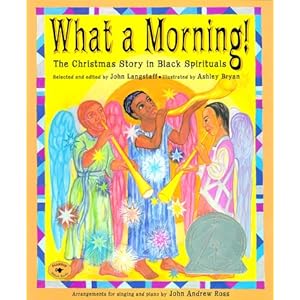
Ashley Bryan's brilliantly colored illustrations look like stained glass, with a black Holy Family and multiracial angels.

Canadian painter William Kurelek depicts a series of dream images in which Mary and the Christ Child appear as Huron Indians, as a black family at a soup kitchen, as seal hunters in an igloo, among cowboys, fisherman, and farmers, in box cars, barns and garages.

Gary Soto tells an everyday story of a modern Latino family at Christmas, with deeply colored, expressive illustrations by Ed Martinez.

Barbara Cooney illustrates a lively Aztec version of the Christmas story, complete with cultural details and beautiful brown angels.

If you observe Christmas, and especially it you share the holiday's traditions with children through books, why not spend the next year adding more color to your collection?