Saturday, December 6, 2008

2. Doing the Research

When I talk to students about the process of creating Talking Walls, I explain that in addition to all the research that author Margy Burns Knight had to do to write the stories, I as the illustrator had to do visual research. I had to make sure that the walls I painted looked like the actual walls. And, I tell them, I even had to do "face research."

I studied many, many photographs and did a lot of sketches to make an accurate representation of the Great Wall of China. Different sections were built with different materials, and the topography of the land affected the design of the Wall in that area. I looked for a segment that was visually dramatic and that was iconic, a definitive and recognizable image of the world's most famous wall.

I had to also be sure that the people I painted on the Wall looked Chinese. Of course there are thousands of ways to "look Chinese," but the people needed to be specifically Chinese, not generically Asian. And I wanted to portray individuals and characters, not generalized representatives of ethnic groups.
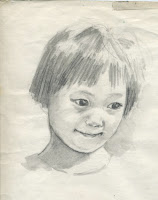
I looked through books of photographs of China until I found one of an irresistible young girl with a winsome smile. She became the inspiration for the child who welcomes the reader and invites them to go on a journey around the world.

Illustrating the Talking Walls books gave me the opportunity to study the facial structures of children all over the world, from Australian Aborigines to the Ndebele of South Africa, Moroccan urbanites to British villagers, Chileans to Tibetans. 

It was like being invited to a visual feast.


Thursday, December 4, 2008

Diversity in Action is ... 1. Knowing What I Don't Know


In 1991, I began working on illustrations for a book called Talking Walls. Author Margy Burns Knight, publisher-editor (and later co-author) Mark Melnicove, and I formed a collaborative creative team which eventually produced five children's nonfiction picture books, all of which are still in print.

All of our titles explore human difference through the lens of what we have in common: walls, immigration stories, baby welcoming rituals, the daily lives of children. The process of creating the books has provided an intensive laboratory for examining how to approach authentic representation of other peoples, cultures and countries.

Talking Walls tells the stories of fourteen walls around the world, on every continent except Antartica. From the beginning of our work together, Margy, Mark and I were conscious that representing that many cultures of which we were not members was a daunting task, and that the only way to approach it was to acknowledge our own ignorance and get lots of help from people who knew more, especially those who did belong to those cultures.

We told lots of people what we were doing and asked for their suggestions of what walls to include. The conversation got so widespread that sometimes we weren't even present for it. At one point, a friend of Margy's who lived in Washington, D.C., happened to discuss the book project with a woman who was Cherokee. The friend explained that the Native American wall we'd chosen was the Anasazi petroglyphs.

"Tell them that's a stupid idea," the Cherokee woman remarked, explaining that the choice was a perpetuation of one of the most persistent stereotypes of American Indians, that they're all people who lived in ancient times, long dead. Fortunately for us and the book, Margy's friend pursued the conversation further. What wall could represent Native Americans? "Taos Pueblo."

Taos Pueblo, we learned in our research, is the oldest continuously occupied dwelling in the United States. Families have been living in the structure for more than 800 years. It's the representation in our book of the walls of a home.

Monday, December 1, 2008

Diversity in Action is ...


"Diversity ... is not casual liberal tolerance of anything not yourself. It is not polite accommodation. Instead, diversity is, in action, the sometimes painful awareness that other people, other races, other voices, other habits of mind, have as much integrity of being, as much claim on the world as you do ... And I urge you, amid all the differences present to the eye and mind, to reach out to create the bond that will protect us all. We are all meant to be here together."

This much-quoted passage, attributed to William M. Chase from a publication entitled "The Language of Action," (I've never been able to find the original source), is one I've loved and lived with for many years. What does it mean to honor the "integrity of being" of others, to "reach out to create the bond that will protect us all?"

In my experience, this ideal can be broken down into a set of skills, behaviors and attitudes which can be learned. Through the next series of entries, I'll share some of the discoveries I've made as I've explored this ideal in concrete form through the creation of children's books.